Another issue was equipment. Not all areas had boats, lightings, and equipment that was required for the character of disaster in a particular area. Each area had different needs. For that reason, the response did not rely on the same pattern for all locations. One critical point was to ensure that villages understood their own area. Villages had to know the threats, the evacuation routes, volunteers’ capacity, and resources they had.
That way, when an outside organisation came, they did not have to start from the beginning. They could start working with the local community who already knew the area and their needs.
We all wanted to help, but there was no leader, then there could be chaotic coordination.
Edi from Cappa Keadilan Ekologis organisation related another experience when responding to forest fire. Then, the organisation did not work by itself. It developed an alliance with a number of organisations. The responses varied, from distribution of food, medicines, and masks masker to constructing canal bocks and helped plant trees to recover the environment. Yet, problem came up when many parties started to get involved without clear role division.
“As there was no central command, because we did not decide who had to take charge, each individual had his/her own mind,” he said. As a result, the inter-organisation roles overlapped. Many organisations decided on the same things, while other needs were not addressed.
Coordination issue was also evident within organisations. Decision already made at top level did not always reach field staff. That experience made them aware that it was not enough for a disaster response to rely on spontaneity and the good will to help.
The Alliance needed space for regular consultation and coordination. Likewise, the alliance needed to make a joint planning since the beginning, including defining priority locations, distribution mechanism, role division, and who had the authority to make decisions. Without those, the response could amount to reactive responses.
One major issue was aid distribution. In disaster situation, people from a number of areas met in one point for aid. Yet, those who lived far from that point did not get any information. “People just come to that point. Some got way too much, while others living far away did not even get any information about aid,” said Edi.
For participants, such experience showed that distribution issue was not simply about logistics. There were also issues about data, coordination, planning, access, ad authority. Aid was abundant, but did not fit the need of the people.
Muhammmad Mansur from Mitra Wacana had experience responding to Merapi eruption in 2010 that showed similar point. Then, community solidarity was tremendous. University students and high school students from Pati who studied in Yogyakarta collected aid for the affected population. Aid came in many forms. There were noodles, rice, bananas, clothes, and other items.
The problem was not all aid fit the need of the people. “The types of aid did not match the actual priority needs of the affected people,” he said. When aid kept coming, most were piling up. In a number of cases, things that were not needed filled the relief centre.
That situation gave critical experience for them as they did not have prior and specific training in humanitarian aid. The response was a form of solidarity. When there was disaster, people felt that they had to do something. Yet, they did not have enough knowledge about how to conduct a need assessment, define priorities, and ensure that aid did not become new burden.
Yet, people’s needs might change as the situation shifted. Aid necessary during the first few days might not have been the same after a few weeks. Mansur said that it was easier to adjust aid such as money distributed during the subsequent phase with the needs of the community. That experience showed the importance of need-based aid, and not simply based on what the donor gave.
When Volunteers Were Not Ready
A similar experience appeared during response to Semeru eruption in 2021. Then, a participant from GKJW, Reverend Yoga was a student and was involved in aid distribution in Pronojiwo, Lumajang. In the response, he worked with local village officials and village deliberation body. Information about needs were collected and distributed through community networks and religious establishments. Yet, data collection issues came up.
Not all volunteers were involved yet they had the competence to do assessment and data collection on people’s needs. Hence, there was not good data collection on necessary information about the types of aid people needed. The other issue was data collection on donation. WE could not know on time how much aid arrived, what types of aid were available, and what other needs were necessary.
This situation made the situation worse. Weather and technical challenges cased data delay. Meetings could only proceed during the night. Delay in information had its impact on the subsequent decision, including types of aid that had to be distributed.
That experience showed that volunteers’ ability was critical part of quality response. Good will alone was not sufficient. Volunteers had to understand how to conduct assessment, manage information, and work in coordination with others.
Floods – Unfinished Business due to Mismanagement
From Yayasan YAPHI, Vera took participants to another experience – flood in Juwana River. She said that river sedimentation and construction of embankments made the flood worse. Water that should have flowed to the sea was clogged and the overflowing water remained for weeks. As a result, aid access became more difficult.
Aid was not well distributed. Affected people were starving at one point because they could not cook by themselves. That experience showed that disaster was not simply related to a natural factor. Environmental management and development policy played important roles as well.
Humanitarian response then faced a bigger issue: How to deal with policies that increased risks? For organisations, that was a serious challenge. Human resources capacity was limited. Response reflected solidarity and social responsibility to affected population, but was not always supported by specific plan for disaster response. Within the district government, mitigation was a major issue.
From Stories to Mapping Issue
After listening to a variety of those stories, the facilitator asked participants to see the common thread. Floods, forest fire, and volcanic eruptions had different characters. Yet, the issues were similar. Here were issues about data and information. There were issues about mistargeted aid as data about needs was not available or was not updated. There was also issues with coordination. Many people were present, but it was never clear who did what, who made decisions, and what the role division was.
There were issues with human resources capacity. Volunteers came to help, but they might not have the competence needed. There were also issues with disaster risks management. Risk assessment was critical need, yet was not available, updated, or used as basis for development planning.
From above process, participants started to group experiences into a number of dimensions. The first was the logistical management or humanitarian aid, particularly in relations to the fit between aid and people’s needs. The second was data management and coordination.
Floods that Did Not Subside, Aid Disrupted
Floods were not simply about water inundating houses and roads. There were issues about environmental management, government policies, organisational capacity, and aid distribution mechanism that determined whether affected people received needed aid or whether they had to keep waiting when the dire situation got worse.
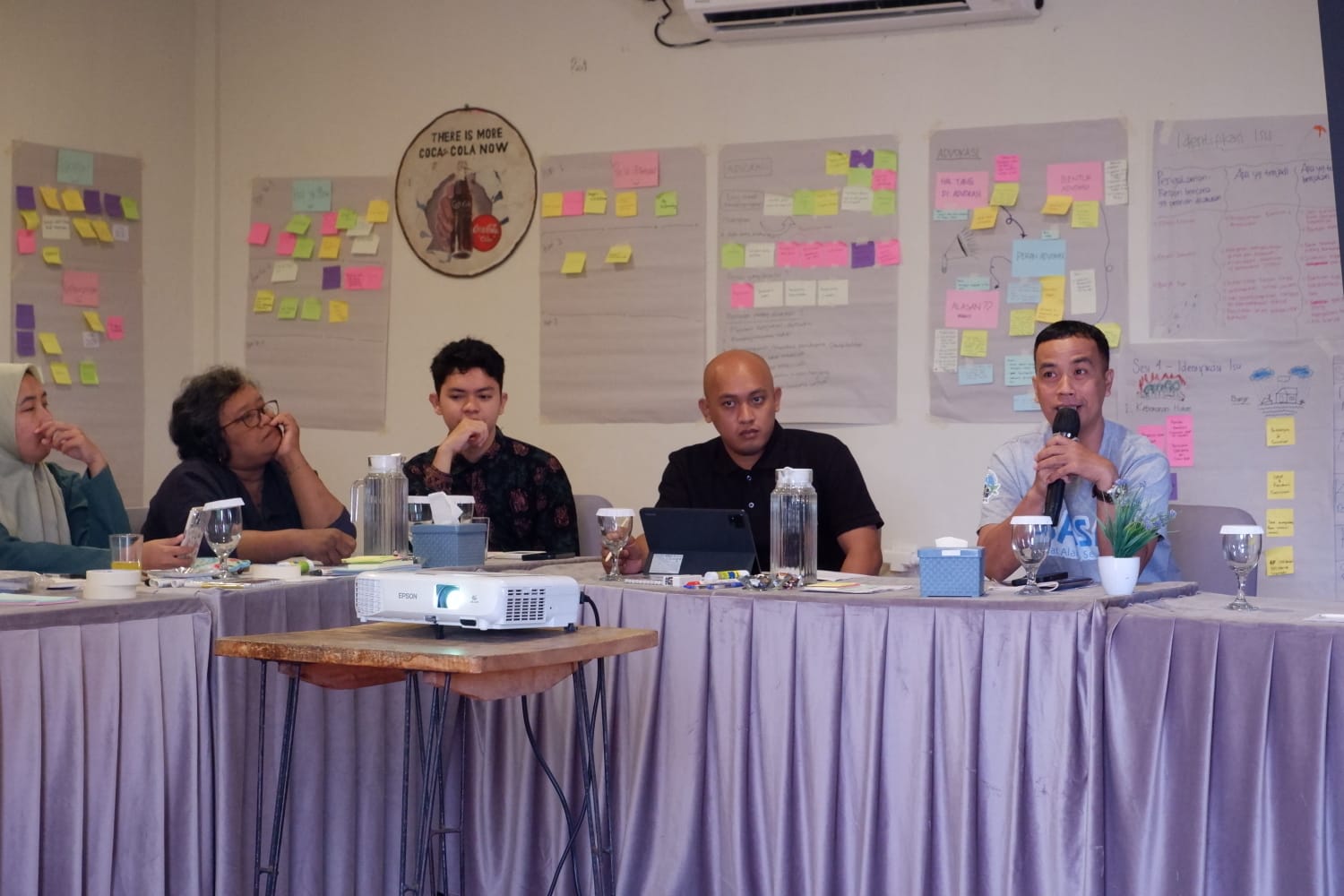
This was clear in the experience shared by Vera from YAPHI when she explained the result of group reflection in the workshop on humanitarian response and advocacy. YAPHI’s experience with flood response was an entry point to see how disaster turned into humanitarian issue when the prevention and response system did not work as intended.
In the case explained by Vera, the issue started when Juwana River suffered sedimentation. Rather than addressing the issue comprehensively, the construction of embankments made situation worse. Water that was supposed to flow into the sea got bogged down and as a result inundation lasted far longer. "Flood water should have flown directly to the sea, but that did not happen,” said Vera when explaining the situation faced by the community.
The impacts were not just on inundated house and the environment. People were also affected, as days of inundation stopped all activities. It was difficult for people to cook as the situation did not allow for that. At the same time, aid distribution did not proceed as planned. “for days, affected communities suffered hunger because they could not cook their own meals,” said Vera.
That situation showed that disaster did not stand alone. There were other inter-related issues, from the environmental condition, development policies, district government capacity, to mechanism for aid distribution. For YAPHI, its involvement in disaster response was inspired by a simple justification: solidarity and social responsibility to the people who had been part of Yaphi’s target groups.
Yet, good will alone was not sufficient as Vera acknowledged that limited human resources and internal capacity were two reasons faced by the organisation when it responded to a disaster. The response was also spontaneous because it did not have any specific plan in its program to integrate a systematic disaster response.
On the other hand, the issue was not limited to the organisation. District government was by no means ready to integrate mitigation and did not have regulations to address disaster risks in its area. Hence, YAPHI’e experience showed the gap between people’s needs and disaster management system preparedness.