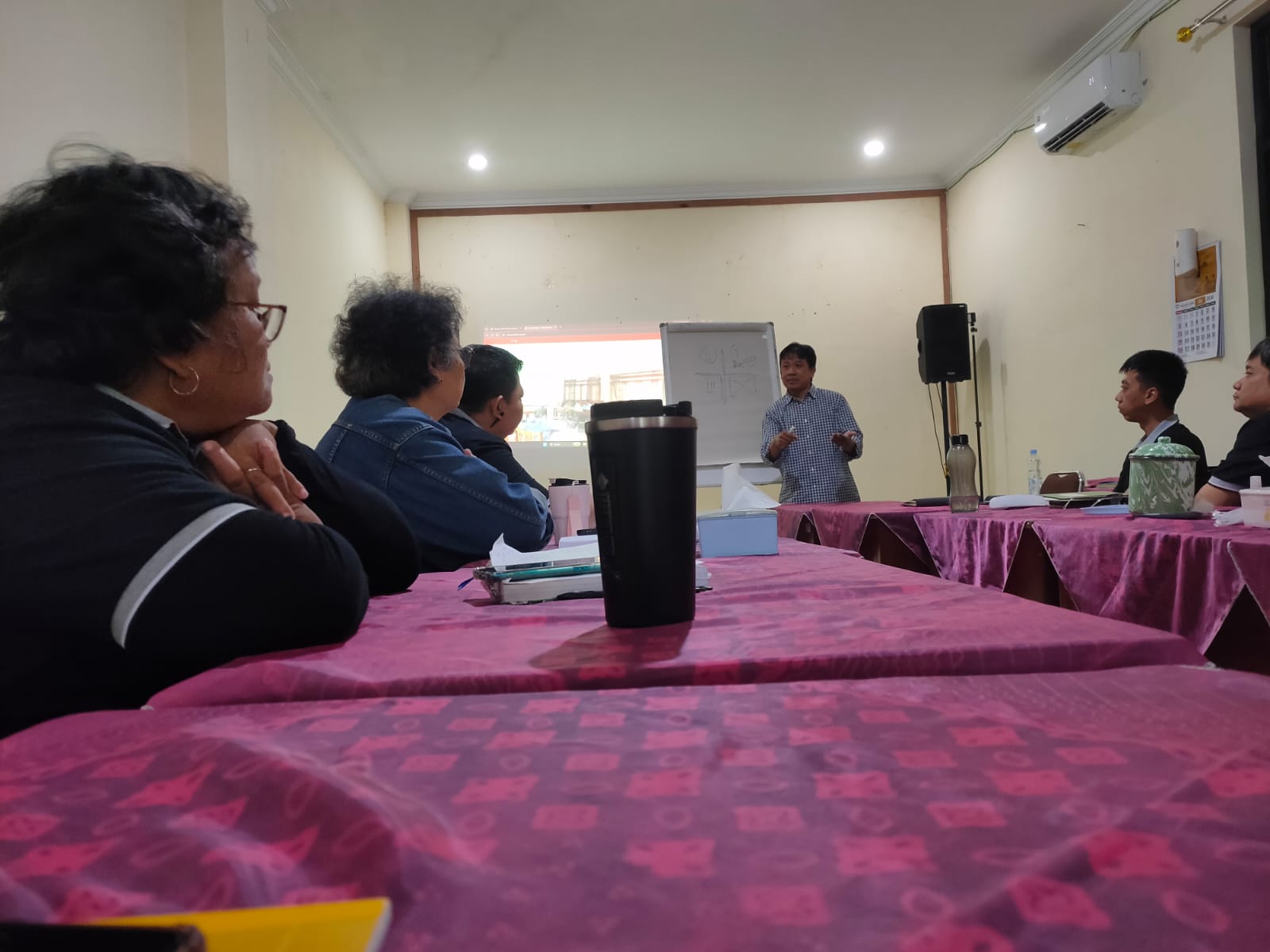
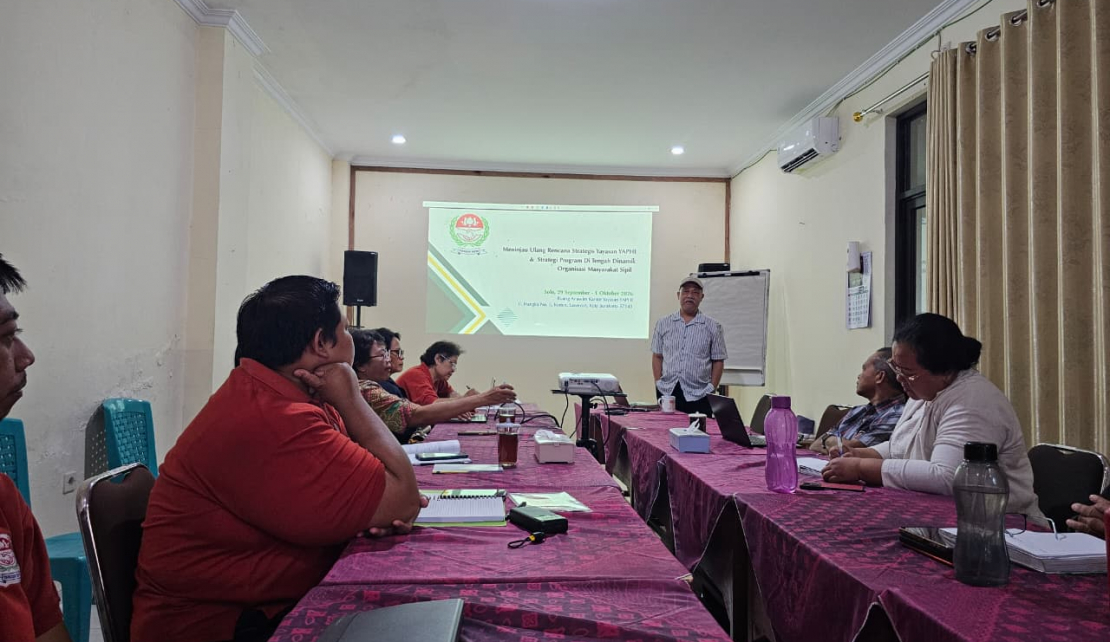
The Anawim Hall at Yayasan YAPHI was the venue to review the organisational journey on Tuesday, 29 September. In that hall, years of experience working with the community were discussed. It was not simply to count how many activities were implemented, how many people were accompanied, or how many reports were completed successfully.
There was a more fundamental question. After so many changes in the community, did YAPHI’s strategic plan remain sufficient to review issues it faced currently?
Andreas Subiyono from Yayasan SHEEP, with extensive experience in strategic planning, asked participants to not rush in making a new document. He said that strategic planning had to be reviewed from the organisation’s own experience. What had changed, what had not changed, what was successful, what was a failure, and particularly what was YAPHI’s strength. Those questions were critical when civil space became narrower, when the issue of human rights became more complex, while funding pattern for civil society organisations changed. Shorter project cycle might force organisations to be preoccupied with implementing activities and meeting indicators. In such situation, the longer-term change objective might be missed.
For that reason, it was not enough to see the measure of organisational work from the number of activities. The more critical question was what changes came out of such activities.
From Activities to Change
One method used to review organisational experience was outcome harvesting. Participants looked into who experienced the changes, what changed, and how changes happened. This method differed from the way organisation prepared programs. In planning, the question was who would feel the changes, what changes would we want to achieve, and how changes had to be promoted.
SOAR (Strengths, Opportunities, Aspirations, and Results) and Theory of Change were critical in helping to see the relationship between organisational strengths, opportunities, intervention, and expected changes. Here, the issue about subjects became critical. Subjects were not YAPHI as the party doing the intervention, but those people expected to experience the changes.
In child protection work, for example, we had to know the number of children, areas, time period, and access to services. We needed to differentiate between availability of services and access to services. An establishment of an organisation working on child protection could be a form of achievement. The question then was whether such an organisation led to families and children getting easier path to protection.
It was similar to agrarian reform. Peasants became subjects to change. What was critical to see was not simply whether the activity (activities) had been done, but how changes happened with regards to land control, protection, management, and the benefits obtained.
Small-business production or improvement in income could be critical change. The relationship with agrarian reform needed to be made clear so that not all changes could be automatically defined as program outcome.
From there, participants distinguished more meticulously between activities, outputs, and outcomes.
Finding the Essence of YAPHI’s Work
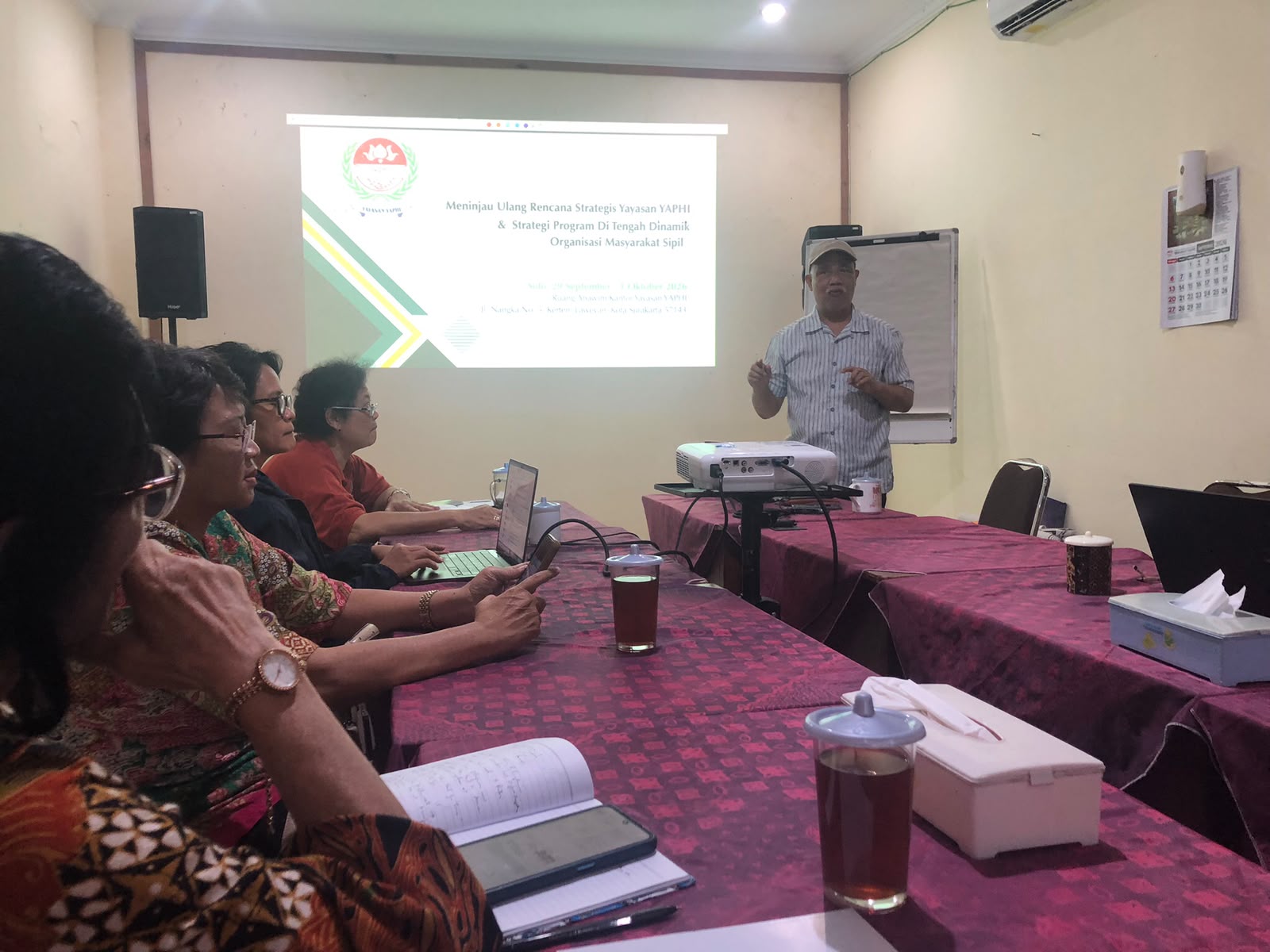
The speaker then asked a deeper question – what was the essence of YAPHI’s work?
Advocacy, education, accompaniment, community organizing, and publication proceeded in a number of forms. The challenge was to ensure all these works remained connected to the organisational objective(s). In community organizing, people tasked with accompaniment were not those who came to save the community. They built contacts, trusts, empathy, partnership, and critical awareness. Community problems were not stand-alone issues. Rights to land could be related to employment. Employment issue could be related to income and family. Education, health, environment, and social condition could be inter-related.
For that reason, experiences in accompaniment had to be documented as organisational knowledge. YAPHI had to become a learning organization, a place where experience did not end when the project finished. It was not enough to store publication as documentation. Media could be important part of the strategy to fight. It could bring issues to the public space, build understanding, and store community path to their struggle.
A question arose about YAPHI’s specialty. Many organisations could provide legal accompaniment, lawsuits, or advocacy targeted at the police. What made YAPHI’s work irreplaceable by other organisations? One answer was its ability to build and communicate evidence.
Data and Evidence Were Not the Same
At the moment, general information could easily be accessible. People could ask the search engine or artificial intelligence when they needed specific information. Then why did people still read YAPHI’s media? The answer lied in evidence drawn from direct experience with the community. YAPHI’s media brought stories about the process of struggling or fighting, changes in relations, experiences in accompaniment, and advocacy work that were not easily obtained from general information search.
We had to make a distinction between data and evidence. Data could be the number of cases, number of participants, size of land, number of services, or measurable changes. Evidence pointed to processes that made those changes possible. An activity photo or certificate did not in itself prove that changes happened. What was critical was to see the relationship between intervention, processes, and changes that happened.
The same question applied to program’s success and failures. If work was successful, what made it work? If work was a failure, what made it fail? The answer to the question could become knowledge that strengthened the organisation.
Dorkas from Yayasan YAPHI took the discussion to the issue of protection of women and children. To date, the iceberg phenomena often appeared when the organisation reported violence situation. The issue became more complicated when the number of complaints increased after campaign and education. Did the increase in the number of complaints mean that violence increased? The answer was not always.
It might be that community awareness increased that led to more people to have the confident to speak and submit their complaints. Previously hidden cases could become more visible. For that reason, indicators had to follow the objective of the intervention. Case management had different measures from campaign. The latter could measure increase in knowledge and awareness. After that, we had to see whether that awareness led to actions. If the measure was protection, the question would be whether communities were increasingly able to protect the children.
Child protection was a broad field. It was not only related to law, but also education, health, safety, child future, inter-generational justice, to climate change. Children in their teens would come face-to-face with the impacts of climate change in their future life. For that reason, protection could also mean ensuring that they had a just future and that they had the ability to deal with changing environment.
Andreas reminded that protection of child’s rights could not be generalised. Early-age children had different needs than school children. Children aged 12 to 18 had other different issues. Three words, protection of child’s rights, brought extensive consequences to program design. Age, needs, forms of intervention, and change indicators had to be clearly articulated.
Accompaniment Did Not Stop with Submitting Complaints
Ninik added that a complaint could open the door to a number of changes. An accompanied child could stay in school. In another case, accompaniment opened access to justice or ensured perpetrator(s) were accountable for their actions.
For that reason, success had to considered in relation to the initial objective of accompaniment. If the objective was continuity of education, then education would be the visible outcome. If the objective was justice, the legal process and results would be parts of the changes. One activity did not automatically result in all forms of change.
Learning from Work on Labour Issue and Policy Advocacy
The question on specificity appeared during work on labour issue. Many organisations had ability to provide legal accompaniment and resolving conflicts. YAPHI needed to find something out of its own experiences. Such experiences could feed into campaign and publication.
Andreas also shared his experience when he was critical of the implementation of Free Nutritious Food Program at schools. A number of schools expressed their rejection based on a number of considerations, from the contents of the food, the potential wasted food, and impacts on catering and local small-businesses, to health issues. The decision was taken after internal process and debates. Field experience was subsequently critical part of the organisational learning.
From there, it was evident that the policy advocacy was not simply about saying I agree or I reject. Organisation had to understand the policy design, the impacts, impacted groups, and the space for influencing policies.
Strategic Plan as the Way Forward
All the discussion finally returned to one need – to ensure that the strategic plan did not turn into a document shelved after it was signed off. Reports of 2023, 2024, 2025, and part of 2026 had to be analysed in conjunction with field experiences, staff reflection, data, and evidence. Programs needed to link to the strategic objective(s). Quantitative data had to be considered in conjunction to qualitative data. Gender-based data had to be consolidated so that different group experiences were not lost in aggregate number. Indicators should not change into objectives. When an indicator was achieved, the question was not whether the work was done or not, but what subsequent changes needed to happen. When an indicator was not achieved, then we needed to look closely which part(s) remained to pay attention to.
Through re-reading, YAPHI was looking for more than simply a list of activities for the next five years. It looked for the essence of the organisation’s work. Who would experience/feel the changes, what changes to fight for, what was YAPHI’s unique feature(s), and what evidence showed that changes were really taking place?
Strategic plan was no longer simply a planning document. It became the means by which the organisation looked into its own journey, and then defined the way forward. (Ast)