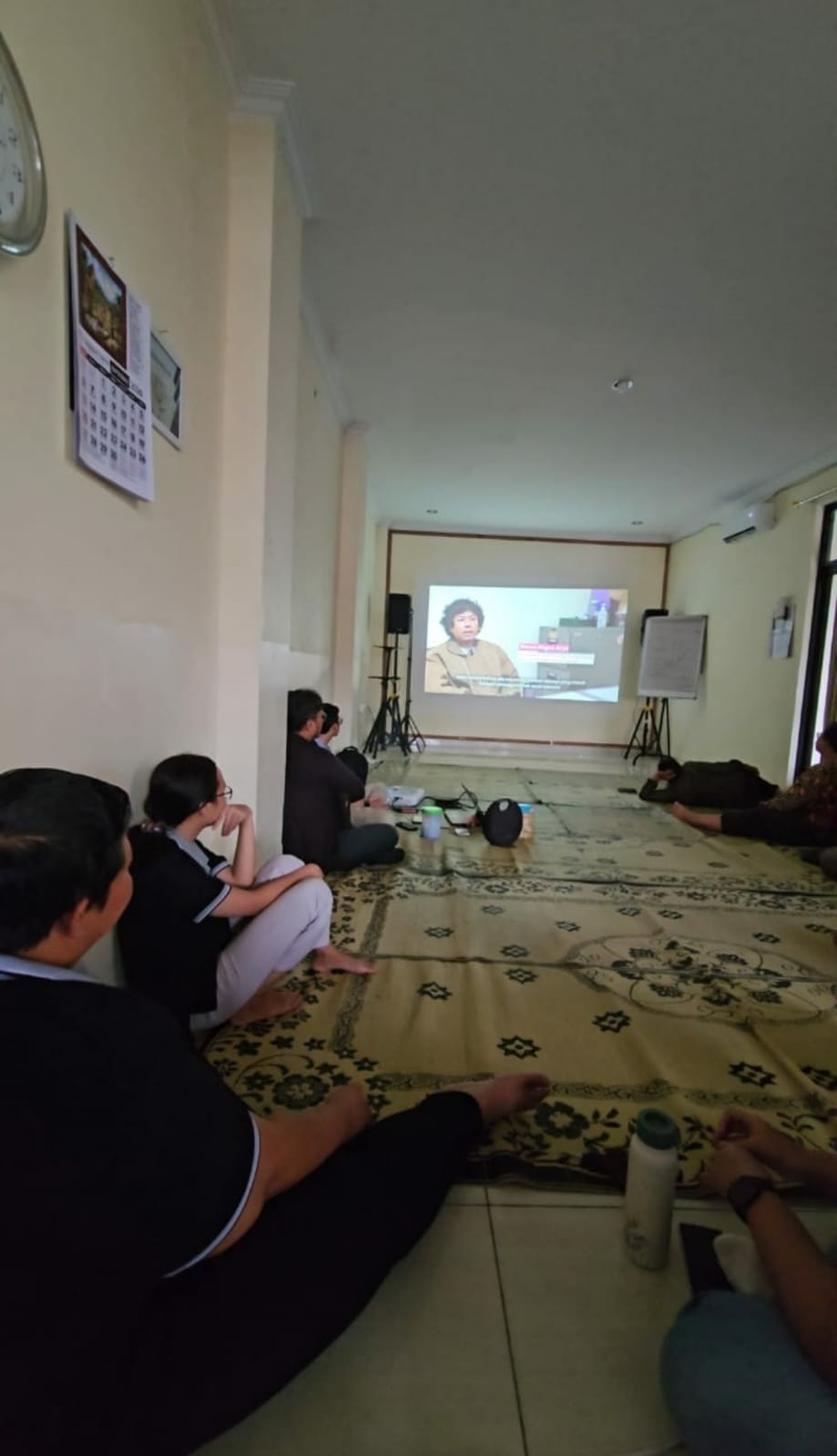
KontraS and a number of civil society organisations set up fact finding commission. The commission consisted of Indonesian Legal Aid Institute (Yayasan Lembaga Bantuan Hukum Indonesia), Legal Aid Institute in Jakarta (Lembaga Bantuan Hukum Jakarta), Amnesty International Indonesia, LBH Pers, SAFEnet, AJI, and a number of researchers. The commission was set up because civil society deemed that the State was too slow in revealing the human rights violations and the violence committed during the protest in August 2025.
Dimas Bagus from KontraS revealed a number of findings on arbitrary arrests. Most people arrested were not participants of the protest. Another finding was about violation of legal procedure, confiscation of freedom, torture and obstacles to access to legal aid.
For Dimas, the issue was not only related to the August 2025 protest. There was a pattern that had to be scrutinised which related to a longer history. He saw the similarity with a number of past incidents, including the Malari 1974 and the May 1998 riot. Such similarity was evident when one observed the mobilisation pattern, escalation of the situation, and the Police actions that worsened the situation. The August 2025 incident had to be viewed more critically.
Criticism of the way the State dealt with protest also led the speaker to the discussion about the Police institution. Arif Maulana from YLBHI explained that the Police position was very strategic in the criminal court system. The Police had the authority to conduct investigation, to execute use of force. The vast authority necessitated critical supervision mechanism. "In the criminal court system, the Police has very strategic position," said Arif.
Arif argued that the vast authority had to be exercised in conjunction to transparency and accountability. People needed means of testing whether arrests, detention, and designating suspect were consistent with the law and human rights standard. The issue was that internal and external supervision towards the Police was weak.
That situation opened the space for impunity. Violence not addressed comprehensively risked to recur. Police reform was one of the recommendations by fact finding team.
Dimas argued that police reform currently proceeding was not good enough to answer such questions. The State needed to show a true intent to reveal facts, to demand accountability from perpetrators of violence, and to prevent similar incidents from happening again. The issue was critical as August 2025 protest did not come out of the vacuum.
Waves of protests were reflection of accumulated people’s dissatisfaction towards issues related to government policies and socio-economic conditions. For citizens, the impacts of State policies were evident in day-to-day life, from employment, basic needs prices, unemployment and public services. Political awareness then grew out of such experience.
People felt they had the right to express criticisms because they were part of the State. They paid taxes, worked, lived with a variety of issues and had expectations of the government.
When criticisms were answered with criminalisation, there were chilling effects. People started to rethink when they wanted to speak. They were afraid to protest. They were afraid to write. Even journalists working to find and present facts could face pressures.
For UGM academic, Prof. Amalinda Savirani, the anxiety which emerged in protest could not be separated from community experience when they dealt with government policies. The impacts were evident in daily life, from prices of basic needs to supply of goods in the market.
For ordinary citizens, the issue was not simply about numbers in government reports. The impacts were present in the daily life of their family and themselves. Economic promises were not fully fulfilled, problems of unemployment, and target for employment opportunity not met added to the anxiety. "The effects for ordinary citizens were real," said Amalinda.
Accumulated anxiety then gave rise to political awareness. They started to question policies they thought were not helping people live day-to-day life. That awareness emerged from people’s position as tax payers with rights to know how the State exercised its authority and used public resources.
To Amalinda, communities could see the impacts of political decisions directly in their life. The issue was not simply about who were in power, but also how that power was exercised and how capable was the government in responding to people’s needs.
For that reason, waves of August 2025 protests were seen in broader context. Public anger did not appear suddenly. There were experience, anxiety, and structural issues that piled up before people finally rose in public spaces. (Ast)