It Was Vital that Draft Human Rights Law Be Reviewed, Vulnerable Groups Highlighted the Discrimination and criminalisation Loopholes

It Was Vital that Draft Human Rights Law Be Reviewed, Vulnerable Groups Highlighted the Discrimination and criminalisation Loopholes
The discussion of Draft Human Rights Law was not simply about what rights were included in the law. There were questions about who got the protection, how that protection was implemented, and how far did the State limit people’s rights.

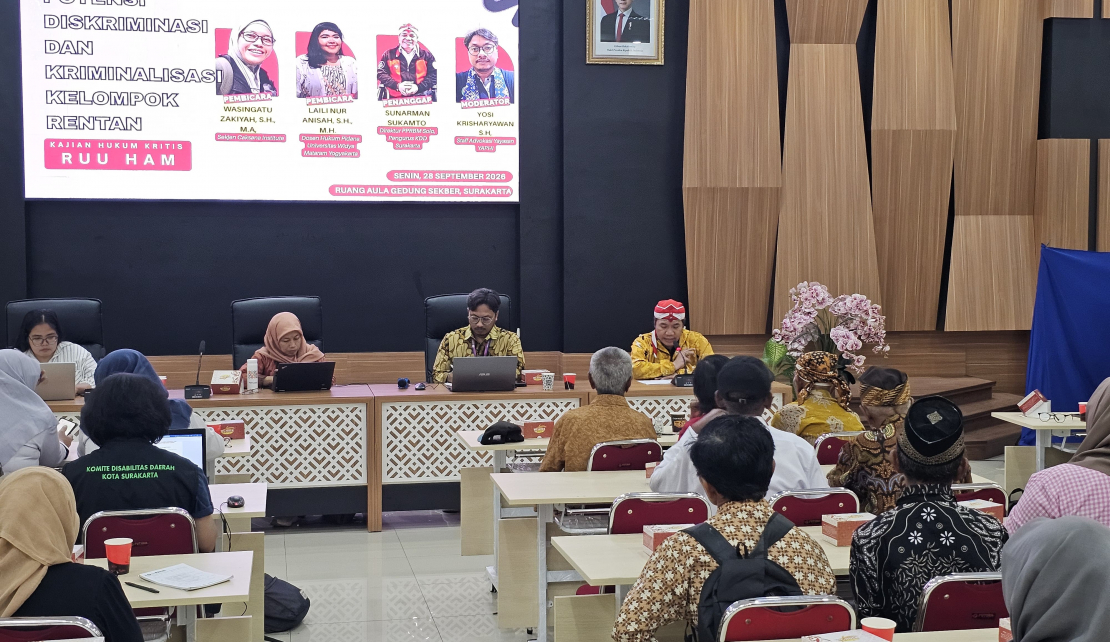
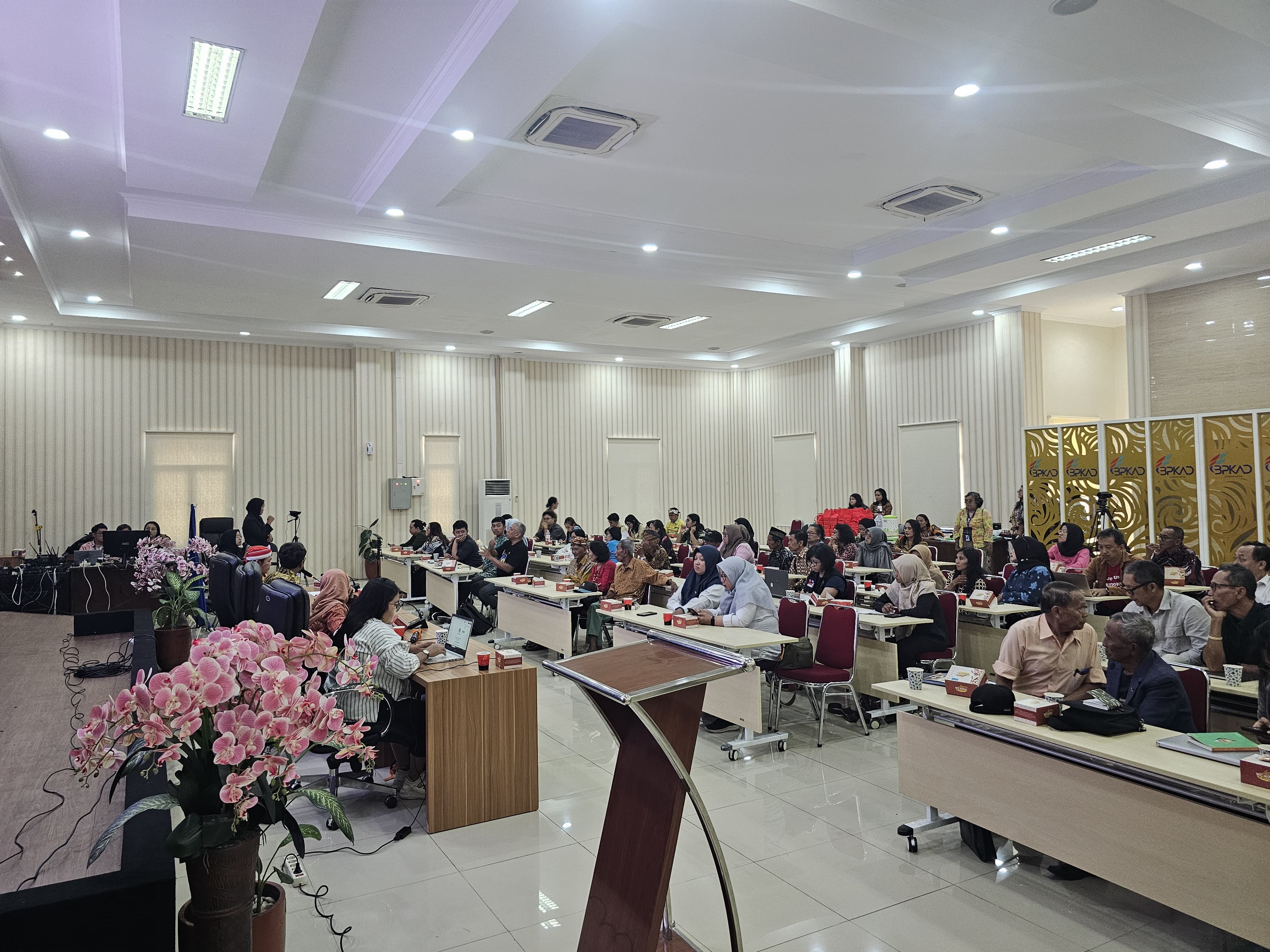
Those questions were highlighted during a Critical Legal Analysis of Draft Human Rights Law entitled “Potentials for Discrimination and Criminalisation of Vulnerable Groups” organised by Yayasan Yekti Angudi Piadeging Hukum Indonesia (YAPHI) in collaboration with City Disability Commission or Komite Disabilitas Daerah (KDD) in Surakarta City, on Monday, 28 September 2026.

The activity proceeded at Aula Gedung Sekretariat Bersama (Sekber) in Surakarta City, Kepatihan Wetan, Jebres involving participants from civil society organisations, disability organisations, and communities accompanied by Yayasan Yaphi. The Forum featured the Secretary General of Caksana Institute Wasingatu Zakiyah, and Criminal Law Lecturer at Universitas (University) Widya Mataram Yogyakarta Laili Nur Anisah. The director of PPRBM Solo and board of KDD Surakarta, Sunarman Sukamto was the respondent. YAPHI advocacy staff, Yosi Krisharyawan was the moderator.

The director of Yayasan YAPHI, Haryati Panca Putri stated in her opening speech that the critical legal analysis was not intended to find faults or to reject the draft law a priori. As a legal aid institute and citizens of Indonesia, the review was an expression of responsibility about the most basic of human rights.

A sign language interpreter was available during the forum. The discussion was also on YouTube. The service was important part of ensuring that the discussion about human rights could be accessible to those groups who were key subjects of the draft law discussion.
Image
Wasingatu Zakiyah, or known as Zakiyah said that the need for a new draft human rights law was vital as there were changes in human rights issue. Technological development presented issues about privacy rights on digital space. Right to clean and healthy environment was also increasingly vital. At the same time, human rights violations were not only perpetrated by State actors, but also by non-State actors such as corporations.

Zakiyah argued that human rights should not simply be relegated to a right catalogue. Such norm had to come with clear mechanism for complaints, investigation, and accountability.

The draft Human Rights Law 5 August 2026 divided the rights regulation into a number of groups. Articles 5–10 focused attention on general rights, Articles 11–38 discussed civil and political rights, Articles 39–53 dealt with economic, social, and cultural rights, while the rights of women, children, people with disability, and indigenous communities were in separate articles. A number of articles received much attention, including Article 51 on Vulnerable Groups, Articles 52 and 54 on Women and Reproductive Rights, Articles 55–61 on Children, Article 62 on People with Disability, Article 64 on Indigenous Communities, and Article 65 on Limit of Human Rights.
In Article 65, use of the terms such as moral, religious values, security, and public order needed to be articulated with extra caution. Too broad terms could result in different interpretation when applied in communities.

Zakiyah also focused on discrimination that rarely occurred in isolation. A person could experience discrimination because of intersectionality of identity, social class, gender, ethnicity, health condition, and disability. For that reason, draft Human Rights Law had to recognise direct, indirect, structural, and intersectional discrimination, and at the same time opened space for affirmative actions.

With regards to disability issue, he saw the importance of a paradigm change. People with disability should not be treated as people needing sympathy or assistance, but as rights holder with choices and independence. Social system and environment that created barriers had to change. Draft human rights law still needed consolidation because it did not articulate clearly descent accommodation as an obligation and did not fully address multi-layered discrimination.

When Law Potentially Became Entry Point for Criminalisation


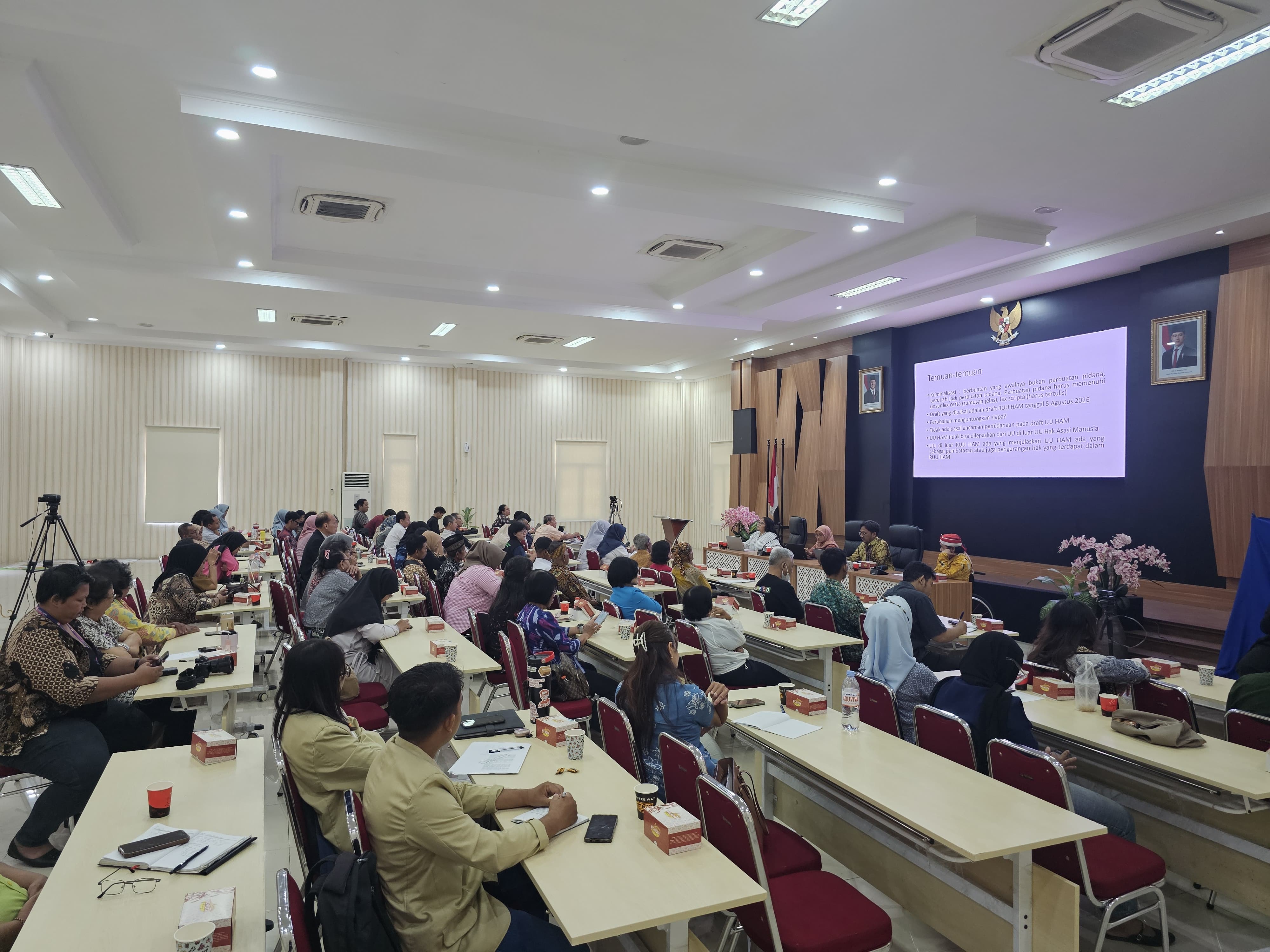
Laili Nur Anisah connected the discussion to criminal law. She explained that criminalisation happened when an action deemed in the past to be non-criminal was then determined to the criminal. For that reason, establishment of criminal articles had to meet the principles of lex certa – a clear and unambiguous articulation – and lex scripta, indicating that the stipulation had to be written. In the draft Human Rights Law 5 August 2026, there was no stipulation about direct criminal penalty. The issue was the draft Human Rights Law did not stand alone. People’s rights were also related to a number of sector-related regulations such as Criminal Code, Law on Information Technology and Electronic Transaction, Health Law, and Law on People with Disability.

Here, Laili asked a more fundamental question – who would benefit from the change in draft human rights law? That question was important in light of the tension between universal human rights and cultural relativism. The universal principle placed human dignity and honour as things to be respected without exception. Meanwhile, religious norms, traditional norms, and certain social could be used to justify limitation for certain groups.

Laili noted a number of articles to scrutinise. Article 8, for example, mentioned five vulnerable groups - women, children, elderly, people with disability, and indigenous communities. The scope had to be ensured so as not to lead to loss of protection for other vulnerable groups.

Articles 32 and 33 defined rights of digital privacy and space, including removal of non-relevant personal information through court and privacy of electronic communication. Articles 45 and 46 defined the rights to housing and property, including protection from eviction and arbitrary confiscation.

Women’s reproductive rights in Article 54 needed extra scrutiny, particularly with regards to the stipulation about exception in abortion. Meanwhile Article 61 prohibited death penalty and life imprisonment for child perpetrators.

For people with disability, Article 62 had to be synchronised more comprehensively with the Convention on the Rights of People with Disability (CRPD). The articulation about corporate social responsibility also needed extra attention to ensure that it did not end up being administrative procedure or shields for companies when they committed violations of human rights.

Another issue was related to Article 103 on Human Rights Defenders. The term “Good Intention” had to articulate clear parameters to avoid one-sided interpretation by law enforcement officials. The State could limit rights under certain conditions. But such limitation had to have clear, written, and non-arbitrary legal basis.

Discussion then moved on from articles in the draft to people’s experience. Sunarman Sukamto or known as Sunarman highlighted the disability and human rights perspectives when reminding that draft Human Rights Law had to truly protect the rights of people with disability. He mentioned twenty-two rights of people with disability, and specific rights of women and children with disability. The big number of people with disability also needed representation in decision-making rooms.

Sunarman argued that affirmative actions were necessary so that people with disability had representation in strategic State institutions. Inclusive democracy was critical part of meeting human rights. Issues about business and human rights were also presented. Business expansion should not lead to loss of livelihood amongst indigenous communities or to environmental destruction. Protection of human rights defenders needed clear articulation, including ensuring that procedural law was not built on view points of people with no disability.
Another participant talked about an issue close to day-to-day practices. Bukik Setiawan focused on the cut in people accompanying marginal groups. He argued that such limitation towards the role of community and civil society organisations caused people to lose space to express themselves.

Abdullah from Islamic Legal Consultation and Legal Aid Institute or Lembaga Konsultasi dan Bantuan Hukum Islam (LKBHI) UIN Raden Mas Said (Islamic University) asked about Article 25 on Debt Agreement arguing that it did not need to be narrowly articulated. He also talked about discrimination against adherents of indigenous belief systems in public services.

Ngadiran from Salatiga asked the difference between ordinary human rights violation and serious human rights violation, and the implementation of non-judicial solution to serious human rights violation in the past.

Meanwhile, Ismail talked about the issue on children with hearing disability. For him, access to sign language was vital from growth to education. Such right had to be guaranteed since early child education to university, including access to sign language for parents so that they could communicate with their children.
Image
One participant asked who had the authority to determine “good intention” for human rights defenders. The participant also questioned how the terms public order and national security were formulated to prevent them from being misused to limit citizens’ criticism. Issues such as wrongful arrests and victim recovery were part of the question. In response, Zakiyah stated that the State should not criminalise people. If a State policy led to labelling, stigma, discrimination, excessive surveillance, rights limitation and criminalisation, such series of actions had to be properly investigated as human rights issues.

She also said that “good intention” could not be determined simply based on subjective statements. Assessment had to look at objective and tested facts based on legality and proportionality of State actions.

Meanwhile, Laili reminded that civil society and academics needed to perform continuous oversights with regards to the discussion of the draft Human Rights Law. The State had to be viewed not simply as party that protected human rights, but also the need to establish mechanism to examine when the State was the one that committed the violations.

For Zakiyah, intervention on human rights violations had to start from the initial stage. Inequality and discrimination unaddressed could turn into bigger problems.

For Sunarman, recognition of legal capacity of people with disability was critical. Terms that demeaned or doubted the capacity of people with disability had to be addressed. Human rights were not simply about the State making regulations, but also about how each citizen was recognised as humans with rights, voices, and capacity in front of the law.

The Forum ended with a plan to collect all of participants’ questions, concerns, and inputs, including those raised or submitted on live Yayasan YAPHI YouTube. YAPHI team would integrate them into official recommendations for advocacy on draft Human Rights Law (Ast)