


YAPHI Disseminates Information about Prevention of Violence against Women and Children at Giri Kinasih Church
By
Hits: 21
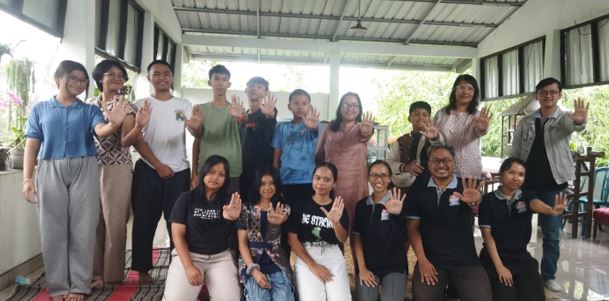
The twelve of us from Yayasan Yaphi arrived at the Giri Kinasih Church (Javanese-Protestant Church) in Girimarto Sub-district, Wonogiri at 13.00. The Church was about one-hundred feet from the Sub-district office. After the welcome, we prepared ourselves for the program that would finish around 6 p.m. that Friday (20/2), and we found ourselves in front of a big table full of food - rice, vegetables and side dish – which we happily enjoyed. Then came the information dissemination about prevention of violence against women and children.
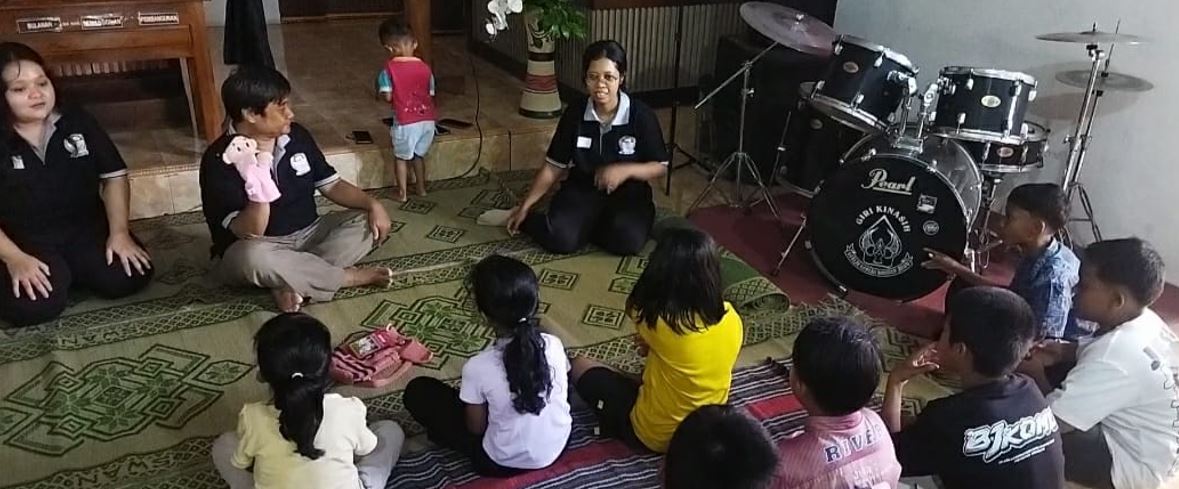
Four-year old Brian moved about actively since we arrived. He joined his friends, children of his age and some slightly older. The facilitator, Adi opened the meeting by introducing himself through game. Before discussing safeguarding, as a guideline to ensure safe and comfortable atmosphere, feelings, activities, and venue for children, he asked the 13 children to sing hymn "Mari kita bersuka ria" (Let us Rejoice) which children sang together as the following,
“Mari kita bersuka ria. Karna ini hari bahagia, kita berkumpul jadi satu, puji Tuhan semesta itu… “ (Let us Rejoice. Because this is a moment of happiness, We gather here as a group, We praise the Lord the Universe…)
Two participants, Nesa and Abi then sang the next song which children sang in Sunday School:
“Kingkong badannya besar, tapi aneh kakinya pendek, lebih aneh binatang bebek, lehernya Panjang kakinya pendek, lebih aneh binatang bebek, lehernya Panjang kakinya pendek, Haleluya Tuhan Maha Kuasa, Haleluya Tuhan Maha Kuasa…(King Kong has a massive body, yet isn’t it odd that it has short legs, but what could be odder than a duck, it has a long neck and short legs, but what could be odder than a duck, it has a long neck and short legs, Hallelujah God is Great, Hallelujah God is Great…)
After a few relaxing and joyous conservation (re. questions and answers), Adi explained the objective of the program, that playing with children was a means to teach children to avoid games such as Roblox, Mobile Legends, and other similar games. “Come on, those who bring their mobile phone, put them here,” said Adi. He facilitated the program with other facilitators - Anissa and Aster.
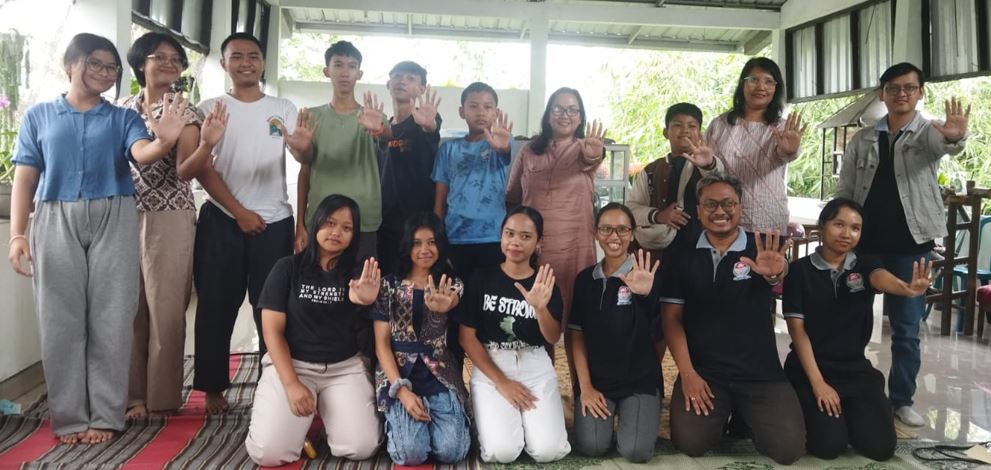
They informed children about the impacts of playing with mobiles phones for too long, and about how to prevent violence by showing them a video, “So please remember ….Do not play with your mobile phone, let us stop bullying, raise your hands, and show that we are all connected for the good.”
A grade 5 boy, Diky answered the question of the author – why do you like to join this activity, and not skipped and went home? He declared. “Here there are so many friends and YAPHI staff challenge us for games. We learned that we should not beat other friends. We should not mock each other. We should not play with our mobile phones when we play games with Yaphi staff,” he said.
“Will you want similar activities?” asked the author, and Diky answered, “I would love to do this again tomorrow. This is more fun than the Sunday School. The lesson is different,” answered Diky who acknowledged that he was a bit tired. Then, the activity ended with each child made drawing on their respective piece of paper.
Meanwhile, in a separate room, nine youth and three mothers acting as the Church Assembly members followed the information dissemination on prevention of violence against women and children provided by Dorkas, Yosi, and Handharu. The introduction session came first, then Dorkas talked about safeguarding – the same guidance she presented at children’s class. Afterwards came the fun part of singing together accompanied by the sound of a guitar.
“Hari ini Kurasa Bahagia”. Hari ini kurasa bahagia, berkumpul bersama, saudara seiman…kau sahabatku. Kau saudaraku. Tak ada yang memisahkan kita…nyanyian diiringi dengan permainan gitar oleh Ega. (Today I am happy – Today I am happy, being together, with children of the same faith…You are my friends. You are my family. Nothing separates us…)
Game Session as a Means to Get to Know Better
A facilitator team, Yosi then asked participants to move their body using group game method about disaster, where 15 participants were divided into five groups where each group had three members. The objective of the game was to train concentration – by focusing on the facilitator’s guidance, and by collaborating together as solid teams.
Cindy, a second grade senior high school student, and Cakra a first grade junior high school student, commented on the same with one word ”Exciting…!”. A Church Assembly member, Anik also expressed that the activity with Yayasan YAPHI gives much more benefits to children than playing with mobile phones.
Dorkas facilitated the next game by exploring, or more exactly through assessment, that could also be used as a pre-Test, by asking a few questions. By closing their eyes, young participants are encouraged to think and to decide whether to answer ‘Yes’ or “No”. Some of those questions were: 1. Boys who do not smoke are not cool, 2. Someone eating porridge and not mixing it first is plain weird, 3. At church, we open the bible in our mobile phones and that would not disturb anyone, 4. If we have a boyfriend/girlfriend we need to know their email and password, 5. WE do not need to ask for permission when we download and upload a friend’s photos, 6. Calling a friend’s name by the friend’s parents’ name or other name is funny, 7. Hitting a child is a means of education, whistling when a person of opposite sex passes by is a form of praise because that person is beautiful or handsome, 8. Eager to make friends with others through social media or online game is ok because the person is good, 9. Children who beg or wing on the street for money shows devotion to their parents, 10. No need to complain because of fear of being labeled a snitch.
Film Presentation
The next session, facilitators played a film made in 2021 by the Ministry of Education and Culture which explored the story of Mahesa and his bullying. After the film presentation, the young people then answered questions given by the facilitators.
After the film presentation came the questions and answers, and then the more serious issue about the definition of prevention of violence against women and children, but first the definition of violence.
What is violence? Each participant answered with their own interpretation, that violence was: cat-calling, degrading bullying, shaming, using swear words, pinching, slapping, shaking, isolating, raping, and hitting.
The reflection session by Handaru became more and more interesting. Participants used masks for blindfolds. Handharu then explained. Participants sat down, some with straight and balanced posture, while some others crossed their legs and looked straight.
“There is a sound qiu qiu qiu …when a woman passes. Then there is the comment about her body and laughter. Some may say it is a compliment. Unless she is attractive then no, the person says. Perhaps we think ah, this is just flirting, but the body knows, the heart beats faster, hands clutching tighter the key to the house. No one knows whether it is safe that day. Some women may go home and choose to be silent…because one mistake would lead to a beating or scolding and we learn that talking about it is dangerous, that crying is shameful, not to mention that each person interpret that cry in different ways. They (victims) look older as something dies in their heart. What is most painful is not only the perpetrator, but also those people who look on without doing anything. There is fear of being labeled a snitch, although deep down one may know that one word may save someone’s life. This is no longer funny. Just one act and it may save life.”
Handharu continued, “Violence not only left scars on a person’s skin but also fear. Fear of being rejected. Fear of being accepted. People may find it difficult to continue living. People may smile in their photos, but may cry in reality and no one knows. If today, anyone of you feel this way, I want you to listen carefully. You are not weak. You are not “damaged.” You are not alone. Hurt is not a sign of failure. Hurt means you persist and it is not easy to persist.
To recover may not seem extraordinary, it may even be small – willing to share with friends, willing to say “I am not comfortable.” Willing to ask for help because asking for help is not a failure, but a new and better beginning for you.
Perhaps today you have choices. Are you going to be people who laugh at others, or are you going to be people who make other people comfortable. You do not have to be heroes, you do not have to be strong, but you do have to care because the person sitting next you may have silently struggle and one good action may save that person’s life. One day people may forget who is the smartest, who is the prettiest/ most handsome, but people will not forget who makes them comfortable. And that person may be you.”
Information Dissemination with Parents
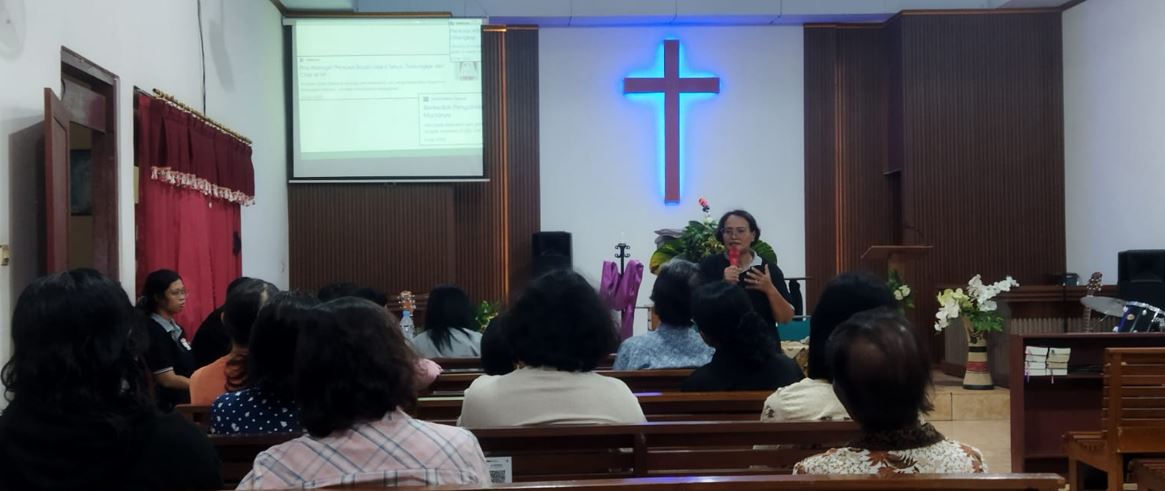
In the afternoon, at the same venue (Giri Kinasih Church), the director of Yayasan Yaphi, Haryati Panca Putri started information dissemination on the prevention of violence against women and children by talking to parents about what Yayasan YAPHI was. “Our objective is to provide services in Yogyakarta Special Province and Central Java through a variety of strategies to protect women and children. In addition, we accompanied 500 victims of serious human rights violation, the incident in 1965/66. The youngest amongst victims was 70 years old, and we served victim regardless of their religions, ethnicity, race, or groups,” said Putri.
Dunung was in charge of the subsequent session. She guided 20 children to a learning session about the meaning of violence and gave time to children to share their stories. “There is no student or teacher here. Before the discussion, I will inform you that there will be documentation and photos, would you be ok with that?” asked Dunung while offering informed consent.
The information dissemination started with news clip from a media about violence in Wonogiri District, while Dunung also displayed data of violence that had happened. Afterwards, she explained using terminology about different kinds of violence, and the impacts once violence happened, as well as why violence against women and children happened. “Why violence against women and children happened? Because it is normalized. Who is most vulnerable? Children, women, and wives. Why are children and women vulnerable? Because they are perceived as weak, economically dependent, and subordinate as they were deemed properties. Patriarchy culture fosters violence. "You make your own choices, now you have to own them," explained Dunung.
The key emphasis during the information dissemination was that there was law on violence. And the first thing that had to be done was to accompany and to empower victims.
(Ast)
Participants – Youths
Participants – children
Participants – Parents